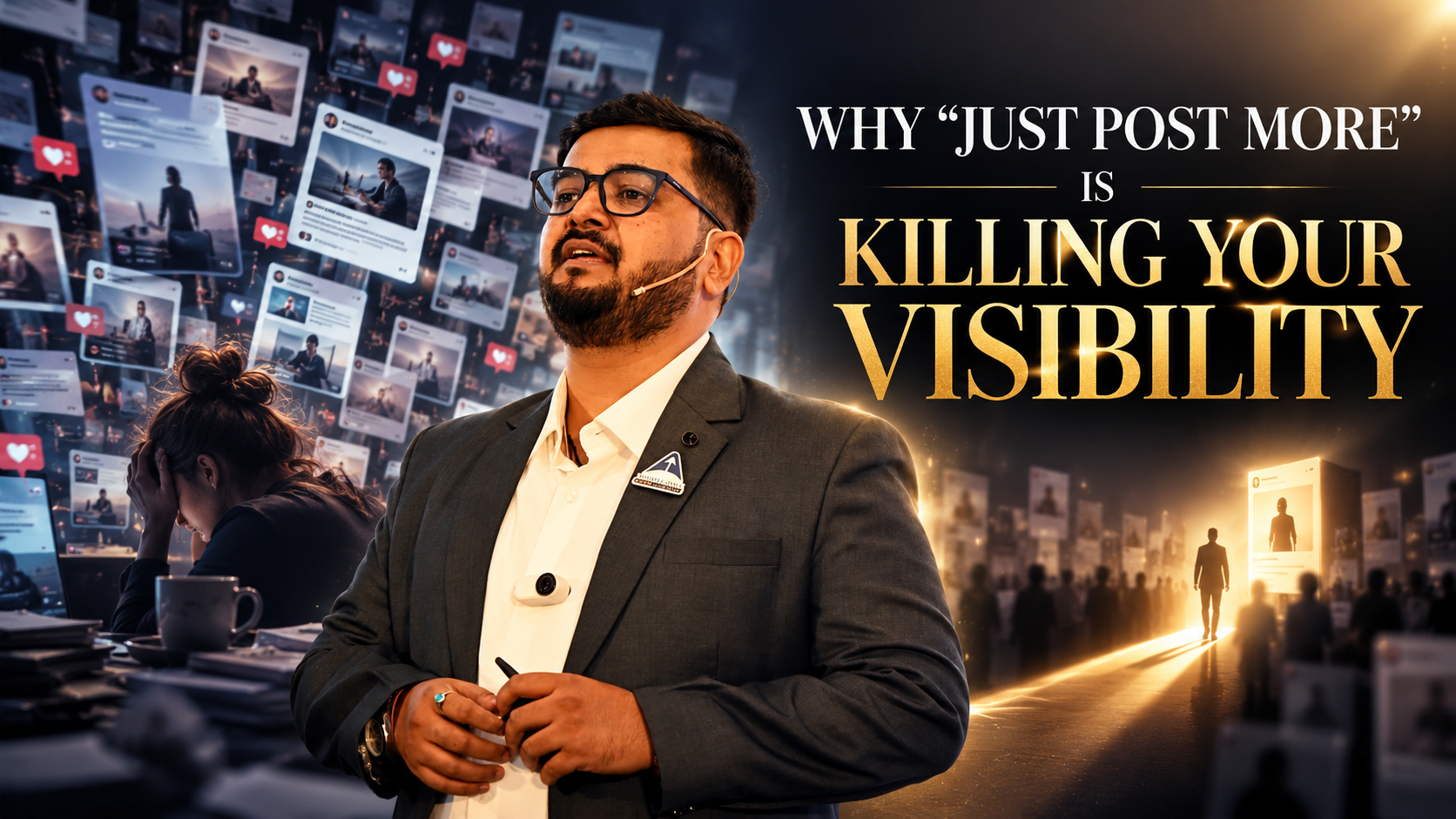
There’s a particular kind of tired that doesn’t show up on a sleep tracker.
I watched it on a video call a few months ago. One of my SME Program students, an ICF-certified coach, dialled in looking like she’d been awake since a war started somewhere. She hadn’t. She’d just posted. Again. Same as every day for the past four months.

Three times a day, across Instagram and LinkedIn. Reels on Tuesdays. Carousels she’d stayed up past midnight designing. A “value post” every single morning before her first coffee, because someone on a webinar had told her that’s what “consistency” looks like.
She had, by any visible metric, done everything right.
And she had zero new coaching clients to show for it.
“I don’t understand,” she told me. “I’m doing more than anyone I follow. Why am I the one who’s invisible?”
That question is the reason this article exists.
The pain point, named plainly

If you’re a coach, consultant, or solopreneur reading this at 11 PM with your phone open to a half-finished caption, here’s what I think you’re actually telling yourself, underneath the content calendar:
If I stop posting, I disappear. If I slow down, someone else takes my spot. The algorithm is punishing me for not showing up enough.
None of that is true. But I understand exactly why it feels true, because “post more” is the single most repeated piece of advice in this industry, and it’s almost always wrong for the person hearing it.
Here’s the uncomfortable number behind it: industry research into the coaching profession in 2025 found that 67% of coaches report severe burnout within their first three years in business, driven in large part by the pressure to “show up everywhere, constantly.” That’s not a rare outcome. That’s the norm. And separately, data on LinkedIn usage shows only about 3% of its members post content consistently at all, which means the platform rewards the few who do show up with real signal, not the ones who flood it with noise.
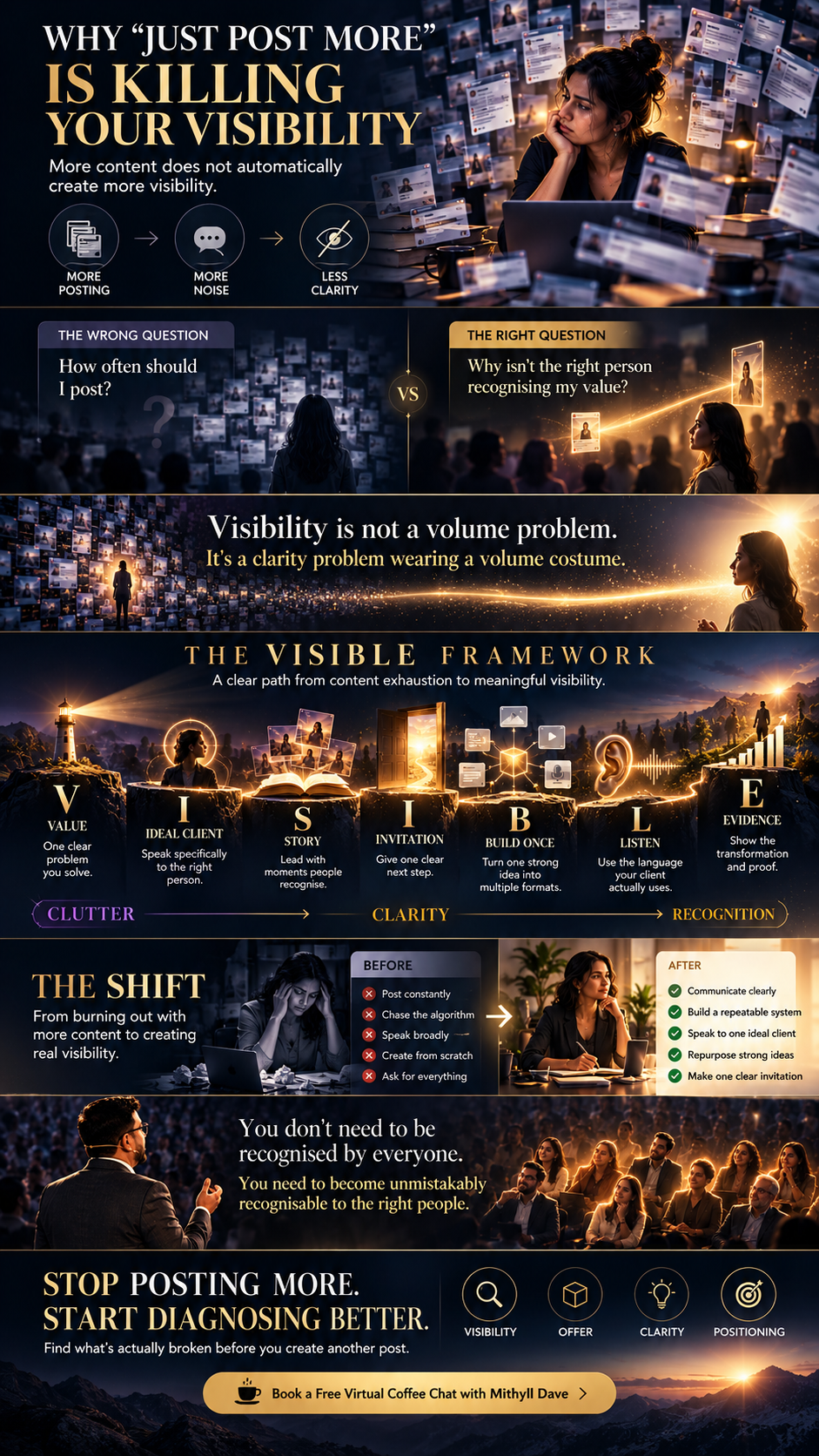
Put those two facts together and you get the actual diagnosis: it was never a volume problem. It was a clarity problem wearing a volume costume.
There’s a line in the Bhagavad Gita that I come back to more than almost any other, because it was written for exactly this moment. Krishna tells Arjuna that his duty is the action itself, done with full attention, not the anxious chase for a result he cannot control. Karmanye vadhikaraste, ma phaleshu kadachana. You have a right to your actions, not to the fruits of them.
My student wasn’t doing her duty. She was performing anxiety fifteen times a week and calling it strategy. Every post was a bid for an outcome, not an act of service to the one person she was trying to reach. That’s exhausting in a way that disciplined, purposeful action never is. Chanakya would have told her the same thing from the other direction: the strategist who reveals everything, to everyone, constantly, has no strategy left to reveal.
The turning point: the VISIBLE framework

When she came in for her Business Roadmap and Strategy session, we didn’t add anything to her calendar. We took almost everything off it. What we built instead was a filter, something I now teach every student who shows up exhausted and invisible. I call it VISIBLE, and it’s the difference between content that’s seen and content that’s merely sent.
V — Value. Name the one problem you solve, for one person, in one sentence. Not “I help people become their best selves.” That’s content fog. “I help mid-career women managers stop freezing in performance reviews” is a lighthouse.
I — Ideal client. Your post should be specific enough that the right person reads it and feels caught, not comforted by something vague. Specificity is what makes strangers feel like you’ve been reading their diary.
S — Story. Lead with a moment, not a mantra. Nobody saves a post that opens with “Here are 5 tips.” Everybody saves a post that opens with a scene they recognize.
I — Invitation. One ask. Every time. “DM me,” “comment below,” “book a call,” pick one, and let the other sixteen things you could have asked for go quiet.
B — Build once. Systemise your content the way you’d systemise a client onboarding flow. One pillar story can become a LinkedIn post, a carousel, and a newsletter, without you starting from a blank page three separate times.
L — Listen. Before you write a single word, go find the exact language your ideal client uses to describe their own problem. Not your language. Theirs.
E — Evidence. Show the win. Not a vague “results speak for themselves,” an actual, specific story of transformation.
That’s it. Six words, not sixty posts a month.
We applied this to her. One clear value statement. One ideal client profile. One story a week, told properly, with one invitation at the end instead of five. She stopped posting on days she had nothing true to say.

Fifteen days later, she signed her first coaching client. From Dubai. Someone who had seen exactly one post, the right one, and recognised herself in it immediately.
Why this matters more than the posting calendar
Here’s the quiet joke in all of this: the people most likely to burn out from “posting more” are the ones with the most actual expertise to offer, because they’re the ones who feel the guilt of silence hardest. The least qualified people on the internet post the most confidently and the least often feel exhausted by it. Draw your own conclusions.
Visibility was never about volume. It’s about being unmistakably recognisable to the right ten people, rather than vaguely familiar to the wrong ten thousand.

If you’ve been grinding on a content calendar that’s draining you and returning nothing, the problem isn’t your discipline. It’s your diagnostic. You don’t need to post more. You need to find out, specifically, what’s actually broken in your visibility, your offer, your clarity, or your positioning, before you create another single piece of content.
Your one next step
If you recognise yourself in that 11 PM feeling, the fastest way out isn’t another framework you read alone. It’s a conversation where someone looks at your actual situation and tells you the truth about what’s broken.
Book a free Virtual Coffee Chat with me, and let’s find your real GROUND diagnostic together, before you write another post.
Frequently Asked Questions:
Why am I posting consistently but still not getting coaching clients?
Posting frequency isn’t the same as visibility. If your content lacks a clear value statement, a specific ideal client, and one consistent call to action, more posts simply means more noise, not more recognition from the right people.
What is the VISIBLE framework for content strategy?
VISIBLE stands for Value, Ideal client, Story, Invitation, Build once, Listen, and Evidence. It’s a filter for making sure every piece of content is built to be recognised by the right person, rather than a formula for posting more often.
How do I know if my content problem is volume or clarity?
If you’ve increased your posting frequency and your engagement or leads haven’t moved, the issue is almost always clarity, not quantity. A proper diagnostic looks at your value statement, your ideal client specificity, and your offer before touching your content calendar at all.