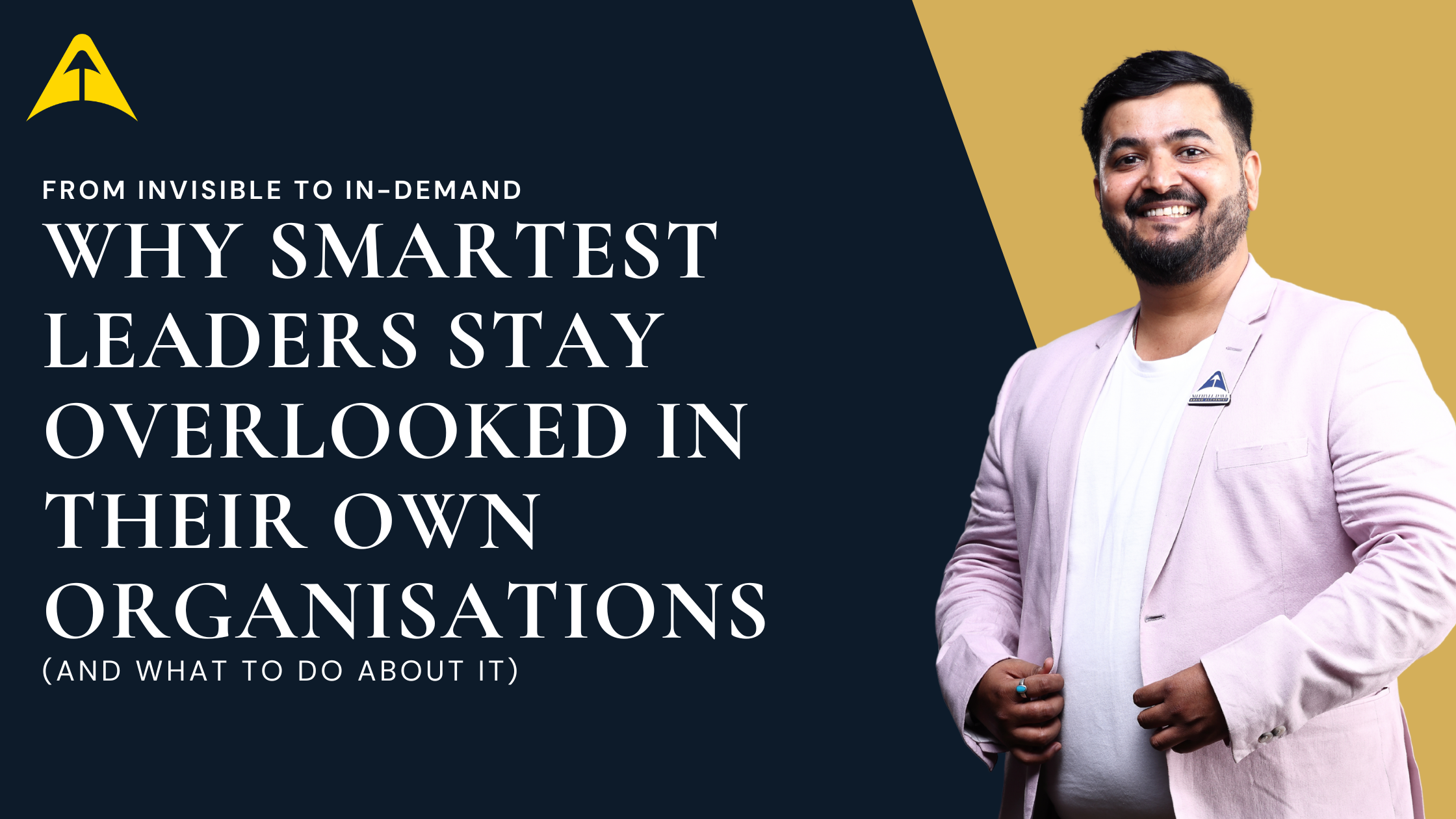
The Question – Why Smartest Leaders Stay Overlooked
Rajesh had spent twenty years in BFSI. He could read a risk matrix the way most people read a menu — quickly, confidently, and with an opinion. He understood the Basel III implications before the regulators had finished circulating the first draft. In every meeting, in every strategy session, in every high-stakes conversation — Rajesh was, without question, the most qualified person in the room.
The MD promotion went to someone else.
Not the most experienced. Not the most credentialed. But someone who had spent the previous eighteen months doing something Rajesh hadn’t — building a visibility architecture inside the organisation. Creating a presence that preceded him. Making his thinking legible to the people who hold career-defining conversations.
Rajesh called me three weeks after the announcement. Not angry. Not bitter. Just genuinely confused. “I don’t understand, Mithyll. I’ve delivered results for two decades. What more does leadership want?”
I asked him one question.
“When was the last time the board understood what you stood for — beyond your function?”
The silence that followed told me everything.

The Problem No One Names in the Boardroom
There’s an assumption that runs deep in corporate India, particularly in BFSI and large technology enterprises. The assumption is this: if you deliver results long enough, recognition will find you. Keep your head down. Do exceptional work. The organisation will reward competence.
It’s a seductive belief. It’s also largely untrue — at the senior leadership level.
75% of senior promotion decisions are influenced not just by performance metrics, but by an executive’s internal brand — how they are perceived, talked about, and remembered across the organisation. — McKinsey Organisational Health Index
Three in four promotions. Think about what that means. You can deliver two decades of results and still lose a critical career moment — if the right people don’t know how to describe your value in a room you’re not in.
This is the gap I’ve spent years observing across senior leaders in BFSI, professional services, and technology. And it has a very specific name.
“Competence is the entry fee. Visibility is how you get promoted.”
Definition · Executive Visibility
Executive visibility is the degree to which a leader’s expertise, perspective, and leadership philosophy is known, understood, and referenced across their organisation and industry — beyond their immediate function. It is distinct from job performance. A leader can have an exceptional track record and near-zero executive visibility. Visibility is built through deliberate communication, consistent positioning, and what I call visibility architecture — a structured system for making your value legible to those who determine your trajectory.
The Three Visibility Gaps That Keep Brilliant Leaders Invisible
In my work with senior leaders across BFSI, technology, and professional services, I’ve identified three specific gaps that quietly undermine the careers of the most capable people in an organisation.
1. Strategic Invisibility
This is the Rajesh problem. You’re known for what you do — not for how you think.
When the C-suite discusses the future direction of the organisation, your name surfaces only in the context of your current role. Not as a strategic voice. Not as someone with a distinct point of view on where the industry is heading. Strategic visibility is about being seen as a thinker, not just an executor.
Here’s the diagnostic question: If someone in your board were asked to articulate your professional philosophy — your beliefs about leadership, your perspective on the sector, your view of what the next five years demand — what would they say?
If the honest answer is “I’m not sure they’d have an answer,” you have a strategic visibility gap.
2. Narrative Invisibility
Rajesh could walk you through a complex derivatives structure with absolute clarity. But when I asked him to tell me his story — the defining moments that shaped his leadership — he went quiet for a long time.
“I don’t really have a story,” he said eventually. “I just… worked.”
This is narrative invisibility. And it’s one of the most common gaps I encounter in technically brilliant leaders.
Stanford researcher Jennifer Aaker found that stories are 22 times more memorable than facts alone. Your track record lives in a spreadsheet. Your promotion case lives in people’s minds. If your colleagues and leadership cannot tell your story, they cannot advocate for you. And most promotions are decided in rooms where advocacy matters enormously.
Your results document performance. Your story demonstrates judgment, character, and leadership philosophy. At the senior level, the latter is what gets you the seat.
3. Influence Invisibility
The third gap is the most subtle — and the most costly. It’s not about what you’ve done or how you narrate it. It’s about whether your thinking travels beyond your immediate circle.
Influential leaders don’t just have opinions. They create movements within organisations. Their frameworks get referenced in other people’s presentations. Their language becomes organisational language. Their ideas show up in strategy decks they weren’t part of writing.
Vikram, a VP at a large private bank, had been running one of the most effective sales enablement programmes in his region for three consecutive years. Measurable results. High retention. Consistent NPS. But outside his own team, virtually no one knew. When a bank-wide initiative was launched that could have been built on his model, they started from scratch — because his influence hadn’t travelled beyond the perimeter of his function.
That is influence invisibility. And it costs the organisation as much as it costs the individual.
The VISIBLE Framework — Applied to the Boardroom
I originally built the VISIBLE framework for coaches and consultants navigating the challenge of building a presence in a crowded digital market. But when I started working intensively with senior corporate leaders, I realised the structural gaps were identical — just wearing a different suit.
VISIBLE maps to the boardroom like this:
Do you have a consistent, recognisable point of view beyond your function? Leaders who advance have a voice that creates direction — not just competence in execution.
What is your leadership signature? Are you known for something beyond your title? Identity is what makes you referable in conversations you’re not part of.
Can you narrate your professional journey in a way that builds credibility and connection? Not a CV recitation — a story with tension, transformation, and a clear worldview.
Do your ideas spread? Are you creating value for people beyond your direct reporting line? Influence is visibility with legs.
What do people say about you when you’re not in the room? Your internal brand is either being built deliberately or by default. There is no neutral position.
Do the right people — board sponsors, cross-functional allies, key decision-makers — know what you stand for and actively seek your perspective?
Are you positioned as the go-to voice on something specific? Expert status inside an organisation is how you become indispensable — not merely dependable. Dependable leaders get retained. Indispensable ones get elevated.
Running your current situation through VISIBLE is a diagnostic exercise. It shows you precisely where the gap is — which is half the battle. The other half is knowing how to close it.
The RAISE Framework: Building Boardroom Authority, Step by Step
Once you understand your gaps, the question becomes: how do you build visibility systematically, without it feeling performative or political?
This is where RAISE comes in. RAISE stands for Research · Architecture · Impact Moment · Signature Story · Engagement. It’s the framework I use with senior leaders to build what I call boardroom authority — a reputation that precedes them and travels further than they do.
R=
Research: Understand the Landscape Before You BuildA =
Architecture: Build a Deliberate Structure for Your VisibilityI =
Impact Moment: Create, Don’t WaitS = Signature Story: The Story That Carries Your Leadership Philosophy
E = Engagement: Convert Visibility Into Influence
Before you position anything, you need to understand what the organisation needs that it isn’t currently getting — at the narrative level. What conversations are happening in the rooms above you? What problems does leadership lose sleep over? Which voices carry weight, and why? This isn’t about playing politics. It’s about strategic alignment — identifying where your expertise intersects with the organisation’s most urgent challenges. Rajesh’s first exercise was a research audit: who were the voices that leadership listened to? What he discovered challenged his assumptions. The leaders getting strategic airtime weren’t always the most technically sophisticated. They were the ones who could connect functional expertise to organisational strategy. That was the gap — and it was exactly where Rajesh had spent twenty years operating.
Architecture answers the question: where will you show up, how often, and on what terms? This includes identifying your two or three core themes — the intersection of your expertise and the organisation’s biggest challenges — and choosing your visibility channels: cross-functional meetings, internal leadership forums, board presentations, industry panels, thought leadership publications. The critical mistake most senior leaders make is showing up brilliantly in isolated moments, but having no architecture that sustains the impression. Architecture turns exceptional individual performances into a recognisable, consistent pattern. And patterns, not performances, are what build reputation at the senior level.
An impact moment is a deliberate, high-stakes contribution that shifts how you are perceived. A bold presentation at a leadership offsite. A white paper that reframes an existing challenge. A cross-functional initiative you champion. A keynote at an industry forum. The key word is deliberate. Most leaders wait for impact moments to find them. RAISE teaches you to engineer them. Maya, a CFO at a mid-size insurance company, designed her impact moment as a board presentation on AI-driven financial risk modelling — six months before it became a priority conversation in her sector. That one presentation changed her internal trajectory within a quarter. She didn’t wait for the wave; she was on the surfboard before it formed.
Your signature story is not your entire career. It is one story — two to three minutes in the telling — that reveals who you are, what you believe, and why you lead the way you do. The strongest signature stories have three elements: a moment of real tension, a decision made under pressure, and a transformation that created lasting conviction. When we worked together, Rajesh’s signature story — once we unearthed it — was from the 2008 financial crisis. A decision he made against consensus that protected his institution from a significant exposure that played out badly for several competitors. Told in three minutes, that story communicated more about his judgment, his risk philosophy, and his leadership identity than any performance review in twenty years had managed to convey.
Visibility without engagement is broadcast. Boardroom authority is built through sustained, meaningful dialogue. This means contributing strategically in forums where your peers and leadership are present — asking the questions that shift the room’s thinking, following through on ideas with visible actions, creating conversations that others want to be part of. Engagement is how visibility compounds into influence. And influence, in an organisational context, is the mechanism by which careers actually advance at the senior level.
The Alchemy That Changes Everything
Rajesh got his next opportunity. Not immediately. Not by chance. But by choosing — deliberately — to stop being the best-kept secret in his own organisation.
He built his visibility architecture. He developed his signature story. He started showing up not louder, but clearer. With a strategic point of view. With a presence that preceded him into rooms he hadn’t entered yet.
Nine months later, he was leading a regional transformation initiative that placed him directly in front of the group board — the very conversation that had felt impossible twelve months earlier.
The capability was always there. What changed was his architecture.
“The real alchemy of leadership is not becoming someone different. It’s making your value legible — to the people who matter, in the moments that count.”
If you’ve spent years delivering results and watching less experienced colleagues advance past you, the answer is rarely to work harder at your function. The answer is to start working on your visibility with the same rigour you’ve applied to everything else in your career.
Your expertise got you here. Your visibility architecture will take you further.
YOUR ACTION THIS WEEK
Answer one question in writing: “What do I want to be known for beyond my title, and does the leadership of my organisation know it?” Be specific. If the answer isn’t clear, that’s precisely where your visibility work begins.
Questions Senior Leaders Are Asking:
-
How do senior leaders build a personal brand without appearing self-promotional?
The most effective executive visibility strategies are never about self-promotion — they are about contribution. When you share a point of view that helps your organisation solve a significant problem, you are not promoting yourself. You are adding value. The personal brand is a byproduct of consistent, relevant contribution to the right conversations. Start with what the organisation needs, not with what you want to be known for. The leaders who build the most credible internal brands are the ones who are obsessively focused on organisational impact — not personal profile. The profile follows.
-
What is Executive Presence Strategy?
Executive presence strategy is a structured approach to building the perception, influence, and authority that enable senior leaders to advance in their organisations and industries. It goes well beyond communication skills or personal style to include deliberate positioning, narrative development, visibility architecture, and sustained engagement with key stakeholders. Frameworks like VISIBLE and RAISE provide a step-by-step methodology for building this systematically — rather than hoping it emerges from tenure and results alone. At its core, executive presence strategy answers: “How do I ensure the right people understand my value — not just my output — at every stage of my career?”
-
Why do Smart Leaders get overlooked by Promotions?
Smart leaders get overlooked because competence and visibility are two separate disciplines — and corporate culture has historically rewarded the first without teaching the second. The gap typically shows up in three forms: strategic invisibility (you are known for your function, not your thinking), narrative invisibility (your career story isn’t told compellingly in the rooms that matter), and influence invisibility (your ideas don’t travel beyond your immediate team). The McKinsey Organisational Health Index research indicates that 75% of senior promotion decisions are influenced by internal brand perception alongside performance metrics. That means being technically excellent is necessary but not sufficient for career advancement at the CXO level.
-
How long does it take to build Executive Visibility?
In my experience working with senior leaders across BFSI, technology, and professional services, meaningful and observable shifts in executive visibility can occur within 90 days of consistent, structured effort using a framework like RAISE. A full visibility architecture — one that creates lasting positioning and sustainable influence — typically takes 6 to 12 months to build and embed. The key variable is not time, but intentionality. Leaders who treat visibility as a strategic priority — not a soft skill add-on — see results significantly faster than those who approach it as an afterthought to their functional work.
Ready to audit your executive visibility?
Business Roadmap Session
In 45 minutes, we’ll map your current visibility gaps against the VISIBLE framework, identify your highest-leverage RAISE step, and build a clear 90-day action architecture.

Written by
Mithyll Dave
The Brand Alchemist™ · The SalesTech Alchemist™
Mithyll is a Mumbai-based global keynote speaker, corporate trainer, and brand strategist with 20+ years in the field. He has trained over 20,000 professionals and coached 200+ CXOs across BFSI, EdTech, and SaaS — with clients including ICICI Prudential, L&T, Axis Bank, and MetLife. He is the author of The Brand Alchemist and From Invisible to In-Demand, and the creator of nine proprietary frameworks — including VISIBLE™, S.E.L.L.™, and SPARK™.
Free 20-minute conversation.
No pitch. Just clarity.