There’s a scene in my book, From Invisible to In-Demand, where a coach named Meera sits in a glass-walled room in Goa and hears a sentence she didn’t ask for.
Madhav, the retreat facilitator & their Business Coach, has just watched four capable, hardworking people defend their effort like it’s under attack. Because in their minds, it is. They’ve done the certifications. Posted the content. Shown up, again and again, at 6 AM calls and client sessions and everything in between.
And still, demand hasn’t shown up the way they expected.
So Madhav says it plainly, no cushioning:
“You don’t lack talent. You lack the courage to decide what you’ll be judged for.”

Nobody in that room breathes for a second.
I want to say the same thing to you, minus the dramatic pause.
If you’re a skilled coach who still feels invisible, your skill was never the problem. You’ve been trying to stay good at many things, because staying broad has felt safer than being judged on one.
That’s the direct answer. Now let’s sit with why it’s true, because rushing past this part is exactly what got you here.
The 11 PM Thought You Haven’t Said Out Loud
You already know the feeling. You close your laptop after a day of “productive” work, posts written, a webinar planned, maybe a new certification half-finished, and a small, cold thought slides in anyway.
I’m good at this. I know I’m good at this. So why isn’t the phone ringing?
And right behind it, the more dangerous thought: Maybe I’m not as good as I think I am.
Here’s what I’ve learned coaching hundreds of talented people out of exactly this spiral: that second thought is a lie your circumstances are telling you. It feels true because it’s the only explanation you’ve got. Nobody ever taught you that talent and demand run on two completely different systems.

Talent is what you can do. Demand is what the world has decided to pay attention to. And the two do not automatically talk to each other, no matter how much effort you throw at the gap.
In the book, Madhav puts it in one line the participants never forget: “Effort creates movement. Not direction.”
Read that twice. It’s not an insult. It’s a diagnosis.
Effort Was Never the Villain, It Was the Disguise
Here’s where I need to be honest with you the way Madhav was honest with that room, no cushioning, no false comfort.
Effort feels moral. It feels like proof of your worth. So when I tell coaches that effort alone isn’t creating their outcomes, they tend to do one of two things. They either argue back, listing every certification and every post as evidence. Or they nod politely and change absolutely nothing.

I’d rather you get uncomfortable with me for the next two minutes than stay comfortable and invisible for another two years.
Because here’s what effort quietly does when it isn’t pointed at a decision: it becomes a hiding place. You get to feel productive without ever risking the thing that actually terrifies you, being judged clearly, for one specific thing, in public.

Staying broad, saying yes to every kind of client, teaching every kind of transformation, posting about everything you know, feels safe. It means nobody can pin you down and say “that didn’t work.” But it also means nobody can point at you and say “that’s exactly who I need.”
Safety and demand have never lived at the same address.
The Question That Actually Diagnoses the Gap
In the retreat, before anyone’s allowed to fix anything, Madhav makes the group sit with three uncomfortable prompts. I want to give you the same three, minus the villa in Goa.
Answer these honestly, in writing, not in your head:
When someone meets you for the first time, what do they usually think you do?
What do you want them to remember you for after that conversation ends?
What problem do you repeatedly help people with, even when you’re not trying to?

If your three answers don’t point in the same direction, here’s the uncomfortable truth: demand cannot form. Not because you lack skill. Because you’re asking the world to recognise a shape you haven’t finished drawing yet.
I’ve watched this exercise land on coach after coach the same way. The relief isn’t in discovering a new skill. It’s in realising they were never behind. They’d simply never aligned the signal they were sending.
This Is Where VISIBLE Comes In
Once that alignment problem is named, the next question is practical: how do you actually rebuild the signal, on purpose, instead of accidentally?
This is the exact gap the VISIBLE framework was built to close. It’s the companion system to the book, and it’s the difference between “being seen” and “being recognised,” which, it turns out, are not the same thing at all.
Voice. Before anything else, you need a defined point of view, not a personality quiz answer, an actual stance the market can recognise as yours.
Identity. Clarify your positioning and your niche so specifically that a stranger could describe what you do after one sentence, not five minutes of you explaining it.
Story. Communicate your authority through signature stories, the kind that get repeated by other people, not just told by you.
Influence. Build the digital presence and credibility signals that let people trust you before they’ve ever spoken to you.
Brand. Create consistency across every platform, so your Instagram, your LinkedIn, and your website all sound like the same human being.
Leads. Attract the right audience with content that’s magnetic to the people you actually want, not everyone.
Expert Status. Become the name people say when someone else asks, “Do you know anyone who does this?”
Notice what’s missing from that list: “work harder.” “Post more.” “Try to be everywhere.” VISIBLE isn’t a hustle framework. It’s a coherence framework. And coherence, not volume, is what recognition is actually built from.
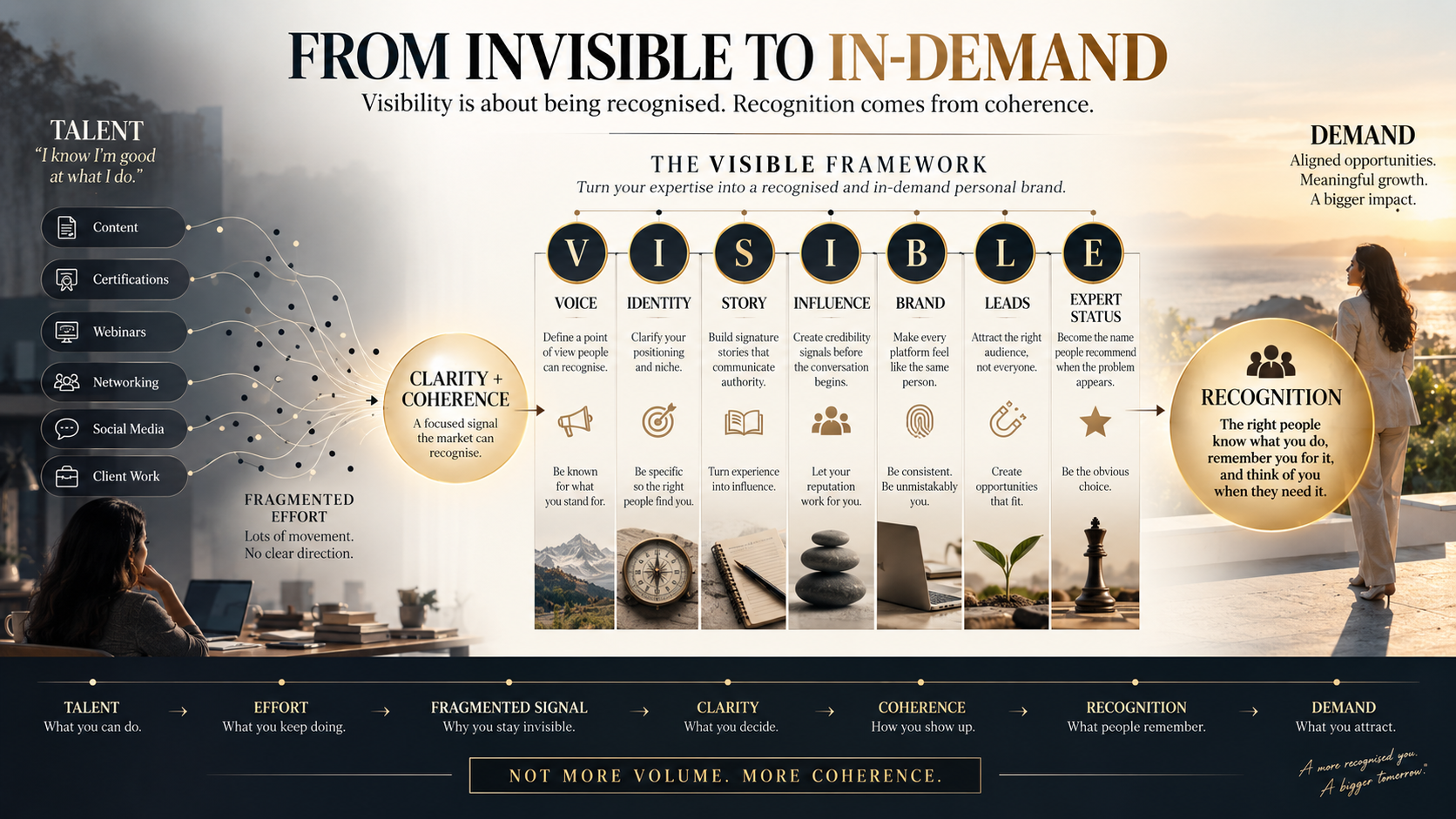
Back in the book, Madhav says it in a single sentence that I still repeat to clients weekly: “Visibility is about being recognised. And recognition doesn’t come from volume. It comes from coherence.”
What Changes When You Stop Hiding Behind Effort
I won’t pretend this shift is instant. It isn’t. The coaches in that Goa retreat didn’t leave with a content calendar. They left with clarity, which, frankly, is a lot less comfortable to hold at first.
But here’s what I’ve watched happen, again and again, once someone runs their brand through VISIBLE instead of just working harder inside the same fog: the referrals start describing them accurately. The DMs stop asking “so what exactly do you do?” The content starts attracting the right five people instead of a hundred wrong ones. And that 11 PM thought, the one that whispers maybe I’m not good enough, finally goes quiet, because it was never about your ability in the first place.
You were never invisible because you lacked talent.
You were invisible because no one taught you how to hold your clarity long enough for the world to respond.
That’s not a flaw. That’s a bridgeable gap.
Ready to close it? Join my free AI Lead Magnet Workshop, where I’ll walk you through applying the first three pillars of VISIBLE to your own brand, live, using AI tools you already have.
Register here: https://rzp.io/rzp/aileadmagnet